Friday, November 21, 2008

More displaced

According to Reeves, approximately half of Darfur's population, which is over three million people (2) have been displaced from their homes and the number continues to grow. More than one hundred people continue to die each day, adding up to around five thousand people dying every month (Darfurscores.org 2). The death rate is so large and continues to grow with such force that the final death toll is estimated to exceed that of Rwanda's genocide, which was "800,000 lives" (Booker et al 1).

If this kind of issue was happening in a more developed country, for example the United States, there would be floods of troops and government supported agencies to help stop these mass murders. The lack of media attention and the lack of concern shown by other nations does not help the crisis in Darfur. By people being aware of the situation and standing by and doing nothing, it enables the Khartoum government and the Janjaweed to continue with their slaughter of innocent people.

The picture above is of a small refugee camp in Chad that thousands of Darfurians now call home after being displaced from their homes.


Booker, Salith, and Ann-Louise Colgan. “Genocide in Darfur.” The Nation. 24 June 2004. 3 Nov
2008. < http://thenation.com/doc/20040712/booker/print>.

Reeves, Eric. “Darfur and the International Criminal Court.” Middle East Report Online. 29
April 2005. 29 Oct 2008. < http://www.merip.org/mero/mero042905.html >.

“Take Action Now.” DarfurScores.org. 2004. 3 Nov 2008.
<http://www.darfurscores.org/takeaction>.

Thursday, November 20, 2008

What is the affect of it all?

The effect of genocide is epic! Even though the issues are not preached about in the news everyday, the problem is significant. In 2004 Booker and his colleagues noted the genocide in Darfur as the "worst humanitarian crisis to be going on in the world." (1) If this was said in 2004, and no big changes have been made to end the crisis, imagine what people would say now after the issue has had almost five years to grow.

Over a million people in Darfur were displaced in 2004, as a result of Janjaweed forces destroying villages, crops, and livestock. A rough "188,000 people seeked refuge in neighboring Chad" (Depoortere et al 1).


Booker, Salith, and Ann-Louise Colgan. “Genocide in Darfur.” The Nation. 24 June 2004. 3 Nov
2008. < http://thenation.com/doc/20040712/booker/print>.

Depoortere, Evelyn, et al. "Violence and mortality in West Darfur, Sudan (2003-04):
epidemiological evidence from four surveys." Lancet 364.9442 (09 Oct. 2004): 1315-
1320. Academic Search Complete. EBSCO. [Library name], [City], [State abbreviation].
11 Nov. 2008 .

Tuesday, November 18, 2008

Pictures are worth a thousand words

Janjaweed soldier heavily armed.


No one is safe from the violence the genocide in Darfur is causing.


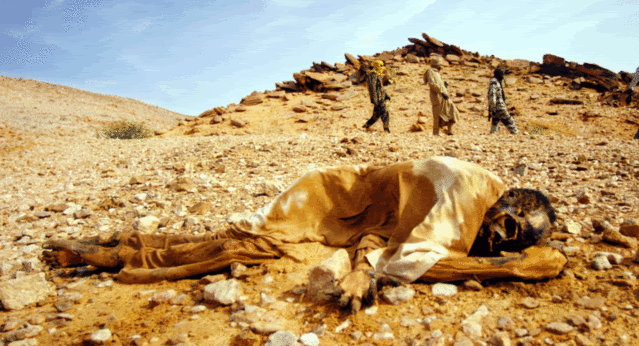
The genocide not only kills people from the murderous acts being carried out by the Janjaweed, but also from starvation. Starvation happens as a result from Janjaweed soldiers destroying the resources.


*PLEASE take note that these pictures may not be suitable for all ages and that the content in which they are displaced is purely for educational purposes in that they are here to help illustrate the severity of the genocide taking place in Darfur, Sudan. *
You can click on the picture and it will take you to the link it was taken from.


Brief History


Since gaining its independence from the United Kingdom in 1956, Darfur has been in constant disarray and as a result of this has cost an estimated 2 million lives (Straus 1). These deaths come from two civil wars and local lineage tensions between the 'African ' farmers and the 'Arab' herders. The issue of genocide came to be as a result from the second civil war, involving the "the Islamist, Khartoum-based national government and two rebel groups; the Sudan Liberation Army and the Justice and Equality Movement" (Depoortere et al 1).


In February 2003, the tension between the Sudan government and the two rebel groups exploded into a heated and prolonged conflict (Totten et al 1). The two rebel groups, in April 2003, attacked a military airfield to protest the government for its neglect to unanswered pleas for political and economical help. Another reason for the rebel attack was the alleged oppression of the Khartoum government on its Black Sudanese population. Instead of "addressing long-term grievances over political and economical marginalization...the regime switched to a policy of destroying" (Reeves 2). This destroying plan was known as a scorched-earth policy. Under this plan of action, civilians of the same ethnicity as the rebel groups (primarily the groups of Massalit, Fur and Zaghawa) were murdered. The government rationalized this policy by an assumption: people of the same ethnic back ground as the rebels most have the same motives as the rebels, making them suspects of challenging Khartoum's authoritarian rule (Booker et al 1). This rationalization gives a whole different meaning to "guilty by association".


The government carried out this systematic method of displacing and murdering African civilians by supporting the recruitment of a militia formed from local Arab tribes (Darfurscroes.org 1-2). This group of "soldiers" call themselves the Janjaweed, meaning 'evil men on horseback'. The name was picked to inspire fear, this properly suits the murderous clan because many of the men are convicted felons and criminals (Hoile 1). These horseback militias were instructed by the Khartoum government to terminate the rebellion. Since that order was made, only a flood of violence and murderous rampages without mercy have followed.


Below are three websites that link to videos. They are a series of a documentary on the Janjaweed. They are interesting to watch because it shows the point of view from the people who are doing the killing.
Play first:
http://www.youtube.com/watch?v=LWSF82GeNTU&feature=related
Play second:
http://www.youtube.com/watch?v=yzfbKn2zJVw&feature=related
Play last:
http://www.youtube.com/watch?v=zTEX-55uxpQ&feature=related


Booker, Salith, and Ann-Louise Colgan. “Genocide in Darfur.” The Nation. 24 June 2004. 3 Nov
2008. <
http://thenation.com/doc/20040712/booker/print>.

Depoortere, Evelyn, et al. "Violence and mortality in West Darfur, Sudan (2003-04):
epidemiological evidence from four surveys." Lancet 364.9442 (09 Oct. 2004): 1315-
1320. Academic Search Complete. EBSCO. [Zach Henderson Library], [Statesboro], [GA].

11 Nov. 2008 http://proxygsu-gso1.galileo.usg.edu/login?url=http://search.ebscohost.com/login.aspx?direct=true&db=a9h&AN=14671492&site=ehost-live.

“Genocide in Darfur, Sudan.” DarfurScores.org. 2004. 3 Nov 2008. < http://www.darfurscores.org/darfur>.

Hoile, David. “The ‘Janjaweed’ Militia in Darfur.” Media Monitors Network . 5 July 2004. 18 Nov 2008. <http://usa.mediamonitors.net/headlines/the_janjaweed_militia_in_darfur>

Reeves, Eric. “Darfur and the International Criminal Court.” Middle East Report Online. 29
April 2005. 29 Oct 2008. <
http://www.merip.org/mero/mero042905.html >.

Straus, Scott. "Darfur and the Genocide Debate." Foreign Affairs 84.1 (Jan. 2005): 123-
133. Business Source Complete. EBSCO. [Zach S. Henderson], [Statesboro],
[GA]. 28 Oct. 2008
http://proxygsu-gso1.galileo.usg.edu/login?url=http://search.ebscohost.com/login.aspx?direct=true&db=bth&AN=15496775&site=ehost-live.

Totten, Samuel, and Eric Markusen.. "The US government Darfur genocide
investigation." Journal of Genocide Research 7.2 (June 2005): 279-290.
Academic Search Complete. EBSCO. [Zach S. Henderson], [Statesboro], [GA]. 28 Oct. 2008
http://proxygsu-gso1.galileo.usg.edu/login?url=http://search.ebscohost.com/login.aspx?direct=true&db=a9h&AN=17267372&site=ehost-live.


Tuesday, November 11, 2008

First Words

Hello! This is my first time as a blogger so please bear with me while I learn the basics and try to present you with the most accurate information that I can while presenting it in a clear way that you will understand.

The purpose of this blog is to inform you about the terrible tragedies that are taking place in the Western part of Sudan, in the region called Darfur. Many may not know but there is a genocide taking place in Darfur for the past five years, since February of 2003. The saddest part is there has not been much change since then. Through this blog you will learn about the history of war and conflict that brought about the genocide in Darfur. You will also learn about the what is going on now, hear live testimonies of people living through the crisis, and learn the solutions and why or why not they are working or being used.